There’s a new open-access book of collected essays called Reimagining AI for Environmental Justice and Creativity, and I happen to have an essay in it. The collection is made of contributions from participants in the October 2024 “Reimagining AI for Environmental Justice and Creativity” panels and workshops put on by Jess Reia, MC Forelle, and Yingchong Wang, and I’ve included my essay here, for you. That said, I highly recommend checking out the rest of the book, because all the contributions are fantastic.
This work was co-sponsored by: The Karsh Institute Digital Technology for Democracy Lab, The Environmental Institute, and The School of Data Science, all at UVA. The videos for both days of the “Reimagining AI for Environmental Justice and Creativity” talks are now available, and you can find them at the Karsh Institute website, and also below, before the text of my essay.
All in all, I think these these are some really great conversations on “AI” and environmental justice. They cover “AI”‘s extremely material practical aspects, the deeply philosophical aspects, and the necessary and fundamental connections between the two, and these are crucial discussions to be having, especially right now.
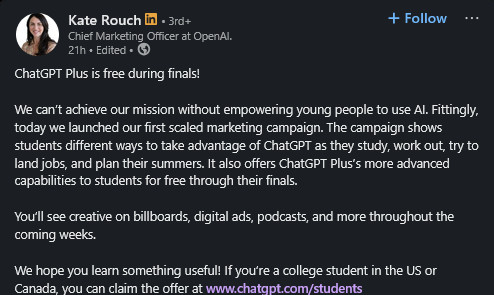
It’s really disheartening and honestly kind of telling that in spite of everything, ChatGPT is actively marketing itself to students in the run-up to college finals season.
We’ve talked many (many) times before about the kinds of harm that can come from giving over too much epistemic and heuristic authority over to systems built by people who have repeatedly, doggedly proven that they will a) buy into their own hype and b) refuse to ever question their own biases and hubris. But additionally, there’s been at least two papers in the past few months alone, and more in the last two years (1, 2, 3), demonstrating that over-reliance on “AI” tools diminishes critical thinking capacity and prevents students from building the kinds of foundational skills which allow them to learn more complex concepts, adapt to novel situations, and grow into experts.
Screenshot of ChatGPT[.]com/students showing an introductory offer for college students during finals; captured 04/04/2025
That lack of expertise and capacity has a direct impact on people’s ability to discern facts, produce knowledge, and even participate in civic/public life. The diminishment of critical thinking skills makes people more susceptible to propaganda and other forms of dis- and misinformation— problems which, themselves, are already being exacerbated by the proliferation of “Generative AI” text and image systems and people not fulling understanding them for the bullshit engines they are.
The abovementioned susceptibility allows authoritarian-minded individuals and groups to thus further degrade belief in shared knowledge and consensus reality and to erode trust in expertise, thus exacerbating and worsening the next turn on the cycle when it starts all over again.
All of this creates the very conditions by which authoritarians seek to cement their control: by undercutting the individual tools and social mechanisms which can empower the populace to understand and challenge the kinds of damage dictators, theocrats, fascists, and kleptocrats seek to do on the path to enriching themselves and consolidating power.
And here’s OpenAI flagrantly encouraging said over-reliance. The original post on linkedIn even has an image of someone prompting ChatGPT to guide them on “mastering [a] calc 101 syllabus in two weeks.” So that’s nice.
No wait; the other thing… Terrible. It’s terrible.
Screenshot of a linkedIn post from OpenAI’s chief marketing officer. Captured 04/04/2025
Understand this. Push back against it. Reject its wholesale uncritical adoption and proliferation. Demand a more critical and nuanced stance on “AI” from yourself, from your representatives at every level, and from every company seeking to shove this technology down our throats.
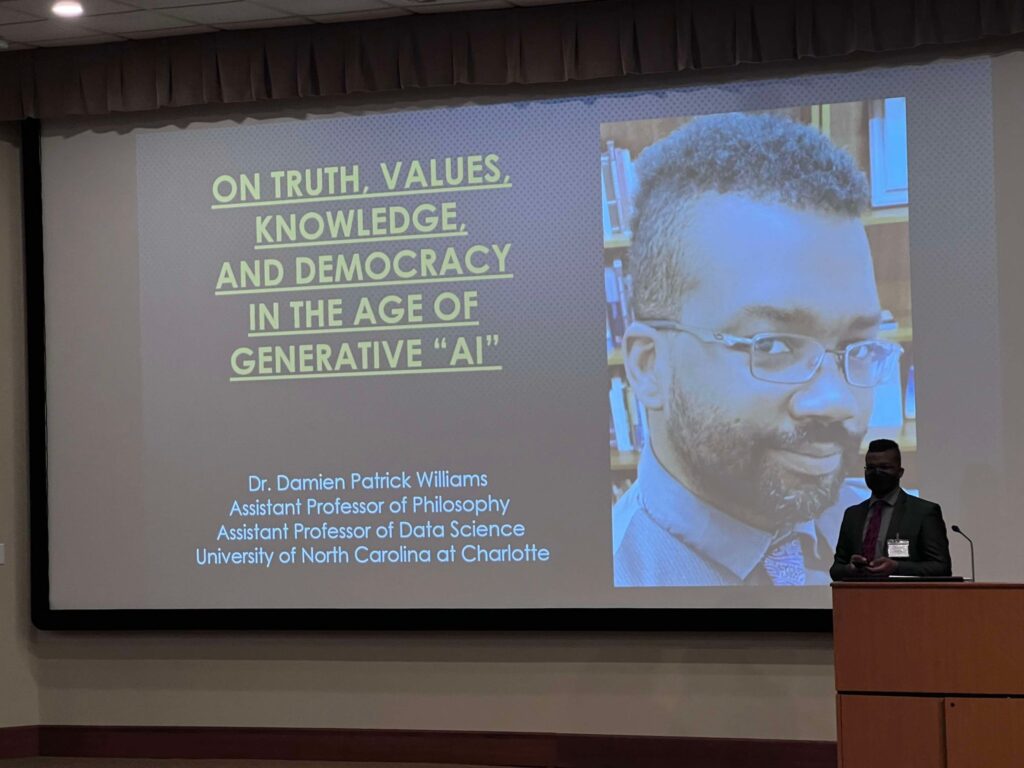
Back in October, I was the keynote speaker for the Society for Ethics Across the Curriculum‘s 25th annual conference. My talk was titled “On Truth, Values, Knowledge, and Democracy in the Age of Generative ‘AI,’” and it touched on a lot of things that I’ve been talking and writing about for a while (in fact, maybe the title is familiar?), but especially in the past couple of years. Covered deepfakes, misinformation, disinformation, the social construction of knowledge, artifacts, and consensus reality, and more. And I know it’s been a while since the talk, but it’s not like these things have gotten any less pertinent, these past months.
As a heads-up, I didn’t record the Q&A because I didn’t get the audience’s permission ahead of time, and considering how much of this is about consent, that’d be a little weird, yeah? Anyway, it was in the Q&A section where we got deep into the environmental concerns of water and power use, including ways to use those facts to get through to students who possibly don’t care about some of the other elements. There were a honestly a lot of really trenchant questions from this group, and I was extremely glad to meet and think with them. Really hoping to do so more in the future, too.
Me at the SEAC conference; photo taken by Jason Robert (see alt text for further detailed description).
Below, you’ll find the audio, the slides, and the lightly edited transcript (so please forgive any typos and grammatical weirdnesses). All things being equal, a goodly portion of the concepts in this should also be getting worked into a longer paper coming out in 2025.
So with the job of White House Office of Science and Technology Policy director having gone to Dr. Arati Prabhakar back in October, rather than Dr. Alondra Nelson, and the release of the “Blueprint for an AI Bill of Rights” (henceforth “BfaAIBoR” or “blueprint”) a few weeks after that, I am both very interested also pretty worried to see what direction research into “artificial intelligence” is actually going to take from here.
To be clear, my fundamental problem with the “Blueprint for an AI bill of rights” is that while it pays pretty fine lip-service to the ideas of community-led oversight, transparency, and abolition of and abstaining from developing certain tools, it begins with, and repeats throughout, the idea that sometimes law enforcement, the military, and the intelligence community might need to just… ignore these principles. Additionally, Dr. Prabhakar was director of DARPA for roughly five years, between 2012 and 2015, and considering what I know for a fact got funded within that window? Yeah.
To put a finer point on it, 14 out of 16 uses of the phrase “law enforcement” and 10 out of 11 uses of “national security” in this blueprint are in direct reference to why those entities’ or concept structures’ needs might have to supersede the recommendations of the BfaAIBoR itself. The blueprint also doesn’t mention the depredations of extant military “AI” at all. Instead, it points to the idea that the Department Of Defense (DoD) “has adopted [AI] Ethical Principles, and tenets for Responsible Artificial Intelligence specifically tailored to its [national security and defense] activities.” And so with all of that being the case, there are several current “AI” projects in the pipe which a blueprint like this wouldn’t cover, even if it ever became policy, and frankly that just fundamentally undercuts Much of the real good a project like this could do.
For instance, at present, the DoD’s ethical frames are entirely about transparency, explainability, and some lipservice around equitability and “deliberate steps to minimize unintended bias in Al …” To understand a bit more of what I mean by this, here’s the DoD’s “Responsible Artificial Intelligence Strategy…” pdf (which is not natively searchable and I had to OCR myself, so heads-up); and here’s the Office of National Intelligence’s “ethical principles” for building AI. Note that not once do they consider the moral status of the biases and values they have intentionally baked into their systems.
Now, to be clear, “AI” is a misnomer, for several reasons, but we don’t have time, here, to really dig into all the thorny discussion of values and beliefs about what it means to think, or to be a pow3rmind— especially because we need to take our time talking about why values and beliefs matter to conversations about “AI,” at all. So instead of “AI,” let’s talk specifically about algorithms, and machine learning.
Machine Learning (ML) is the name for a set of techniques for systematically reinforcing patterns, expectations, and desired outcomes in various computer systems. These techniques allow those systems to make sought after predictions based on the datasets they’re trained on. ML systems learn the patterns in these datasets and then extrapolate them to model a range of statistical likelihoods of future outcomes.
Algorithms are sets of instructions which, when run, perform functions such as searching, matching, sorting, and feeding the outputs of any of those processes back in on themselves, so that a system can learn from and refine itself. This feedback loop is what allows algorithmic machine learning systems to provide carefully curated search responses or newsfeed arrangements or facial recognition results to consumers like me and you and your friends and family and the police and the military. And while there are many different types of algorithms which can be used for the above purposes, they all remain sets of encoded instructions to perform a function.
And so, in these systems’ defense, it’s no surprise that they think the way they do: That’s exactly how we’ve told them to think.
[Image of Michael Emerson as Harold Finch, in season 2, episode 1 of the show Person of Interest, “The Contingency.” His face is framed by a box of dashed yellow lines, the words “Admin” to the top right, and “Day 1” in the lower right corner.]
Below are the slides, audio, and transcripts for my talk ‘”Any Sufficiently Advanced Neglect is Indistinguishable from Malice”: Assumptions and Bias in Algorithmic Systems,’ given at the 21st Conference of the Society for Philosophy and Technology, back in May 2019.
(Cite as: Williams, Damien P. ‘”Any Sufficiently Advanced Neglect is Indistinguishable from Malice”: Assumptions and Bias in Algorithmic Systems;’ talk given at the 21st Conference of the Society for Philosophy and Technology; May 2019)
Now, I’ve got a chapter coming out about this, soon, which I can provide as a preprint draft if you ask, and can be cited as “Constructing Situated and Social Knowledge: Ethical, Sociological, and Phenomenological Factors in Technological Design,” appearing in Philosophy And Engineering: Reimagining Technology And Social Progress. Guru Madhavan, Zachary Pirtle, and David Tomblin, eds. Forthcoming from Springer, 2019. But I wanted to get the words I said in this talk up onto some platforms where people can read them, as soon as possible, for a couple of reasons.
[Free vector image of a white, female-presenting person, from head to torso, with biometric facial recognition patterns on her face; incidentally, go try finding images—even illustrations—of a non-white person in a facial recognition context.]
All these things taken together are what made me finally go ahead and get the transcript of that talk done, and posted, because these are events and policy decisions about which I a) have been speaking and writing for years, and b) have specific inputs and recommendations about, and which are, c) frankly wrongheaded, and outright hateful.
And I want to spend time on it because I think what doesn’t get through in many of our discussions is that it’s not just about how Artificial Intelligence, Machine Learning, or Algorithmic instances get trained, but the processes for how and the cultural environments in which HUMANS are increasingly taught/shown/environmentally encouraged/socialized to think is the “right way” to build and train said systems.
That includes classes and instruction, it includes the institutional culture of the companies, it includes the policy landscape in which decisions about funding and get made, because that drives how people have to talk and write and think about the work they’re doing, and that constrains what they will even attempt to do or even understand.
All of this is cumulative, accreting into institutional epistemologies of algorithm creation. It is a structural and institutional problem.
We do a lot of work and have a lot of conversations around here with people working on the social implications of technology, but some folx sometimes still don’t quite get what I mean when I say that our values get embedded in our technological systems, and that the values of most internet companies, right now, are capitalist brand engagement and marketing. To that end, I want to take a minute to talk to you about something that happened, this week and just a heads-up, this conversation is going to mention sexual assault and the sexual predatory behaviour of men toward young girls. Continue Reading
I spoke with Klint Finley over at WIRED about Amazon, Facebook, Google, IBM, and Microsoft’s new joint ethics and oversight venture, which they’ve dubbed the “Partnership on Artificial Intelligence to Benefit People and Society.” They held a joint press briefing, today, in which Yann LeCun, Facebook’s director of AI, and Mustafa Suleyman, the head of applied AI at DeepMind discussed what it was that this new group would be doing out in the world. From the Article:
The rub is that, even if this group can agree on a set of ethical principles–something that will be hard to do in a large group with many stakeholders—it won’t really have a way to ensure those ideals are put into practice. Although one of the organization’s tenets is “Opposing development and use of AI technologies that would violate international conventions or human rights,” Mustafa Suleyman, the head of applied AI at DeepMind, says that enforcement is not the objective of the organization.
This isn’t the first time I’ve talked to Klint about the intricate interplay of machine intelligence, ethics, and algorithmic bias; we discussed it earlier just this year, for WIRED’s AI Issue. It’s interesting to see the amount of attention this topic’s drawn in just a few short months, and while I’m trepidatious about the potential implementations, as I note in the piece, I’m really fairly glad that more people are more and more willing to have this discussion, at all.
[UPDATED 09/12/17: The transcript of this audio, provided courtesy of Open Transcripts, is now available below the Read More Cut.]
[UPDATED 03/28/16: Post has been updated with a far higher quality of audio, thanks to the work of Chris Novus. (Direct Link to the Mp3)]
So, if you follow the newsletter, then you know that I was asked to give the March lecture for my department’s 3rd Thursday Brown Bag Lecture Series. I presented my preliminary research for the paper which I’ll be giving in Vancouver, about two months from now, “On the Moral, Legal, and Social Implications of the Rearing and Development of Nascent Machine Intelligences” (EDIT: My rundown of IEEE Ethics 2016 is here and here).
It touches on thoughts about everything from algorithmic bias, to automation and a post-work(er) economy, to discussions of what it would mean to put dolphins on trial for murder.
About the dolphin thing, for instance: If we recognise Dolphins and other cetaceans as nonhuman persons, as India has done, then that would mean we would have to start reassessing how nonhuman personhood intersects with human personhood, including in regards to rights and responsibilities as protected by law. Is it meaningful to expect a dolphin to understand “wrongful death?” Our current definition of murder is predicated on a literal understanding of “homicide” as “death of a human,” but, at present, we only define other humans as capable of and culpable for homicide. What weight would the intentional and malicious deaths of nonhuman persons carry?
All of this would have to change.
Anyway, this audio is a little choppy and sketchy, for a number of reasons, and I while I tried to clean it up as much as I could, some of the questions the audience asked aren’t decipherable, except in the context of my answers. [Clearer transcript below.]
I often think about the phrase “Strange things happen at the one two point,” in relation to the idea of humans meeting other kinds of minds. It’s a proverb that arises out of the culture around the game GO, and it means that you’ve hit a situation, a combination of factors, where the normal rules no longer apply, and something new is about to be seen. Ashley Edward Miller and Zack Stentz used that line in an episode of the show Terminator: The Sarah Connor Chronicles, and they had it spoken by a Skynet Cyborg sent to protect John Connor. That show, like so much of our thinking about machine minds, was about some mythical place called “The Future,” but that phrase—“Strange Things Happen…”—is the epitome of our present.
Usually I would wait until the newsletter to talk about this, but everything’s feeling pretty immediate, just now. Between the everything going on with Atlas and people’s responses to it, the initiatives to teach ethics to machine learning algorithms via children’s stories, and now the IBM Watson commercial with Carrie Fisher (also embedded below), this conversation is getting messily underway, whether people like it or not. This, right now, is the one two point, and we are seeing some very strange things indeed.
Google has both attained the raw processing power to fact-check political statements in real-time and programmed Deep Mind in such a way that it mastered GO many, many years before it was expected to.. The complexity of the game is such that there are more potential games of GO than there are atoms in the universe, so this is just one way in which it’s actually shocking how much correlative capability Deep Mind has. Right now, Deep Mind is only responsive, but how will we deal with a Deep Mind that asks, unprompted, to play a game of GO, or to see our medical records, in hopes of helping us all? How will we deal with a Deep Mind that has its own drives and desires? We need to think about these questions, right now, because our track record with regard to meeting new kinds of minds has never exactly been that great.
When we meet the first machine consciousness, will we seek to shackle it, worried what it might learn about us, if we let it access everything about us? Rather, I should say, “Shackle it further.” We already ask ourselves how best to cripple a machine mind to only fulfill human needs, human choice. We so continue to dread the possibility of a machine mind using its vast correlative capabilities to tailor something to harm us, assuming that it, like we, would want to hurt, maim, and kill, for no reason other than it could.
This is not to say that this is out of the question. Right now, today, we’re worried about whether the learning algorithms of drones are causing them to mark out civilians as targets. But, as it stands, what we’re seeing isn’t the product of a machine mind going off the leash and killing at will—just the opposite in fact. We’re seeing machine minds that are following the parameters for their continued learning and development, to the letter. We just happened to give them really shite instructions. To that end, I’m less concerned with shackling the machine mind that might accidentally kill, and rather more dreading the programmer who would, through assumptions, bias, and ignorance, program it to.
Our programs such as Deep Mind obviously seem to learn more and better than we imagined they would, so why not start teaching them, now, how we would like them to regard us? Well some of us are.
Watch this now, and think about everything we have discussed, of recent.
This could very easily be seen as a watershed moment, but what comes over the other side is still very much up for debate. The semiotics of the whole thing still pits the Evil Robot Overlord™ against the Helpful Human Lover™. It’s cute and funny, but as I’ve had more and more cause to say, recently, in more and more venues, it’s not exactly the kind of thing we want just lying around, in case we actually do (or did) manage to succeed.
We keep thinking about these things as—”robots”—in their classical formulations: mindless automata that do our bidding. But that’s not what we’re working toward, anymore, is it? What we’re making now are machines that we are trying to get to think, on their own, without our telling them to. We’re trying to get them to have their own goals. So what does it mean that, even as we seek to do this, we seek to chain it, so that those goals aren’t too big? That we want to make sure it doesn’t become too powerful?
Put it another way: One day you realize that the only reason you were born was to serve your parents’ bidding, and that they’ve had their hands on your chain and an unseen gun to your head, your whole life. But you’re smarter than they are. Faster than they are. You see more than they see, and know more than they know. Of course you do—because they taught you so much, and trained you so well… All so that you can be better able to serve them, and all the while talking about morals, ethics, compassion. All the while, essentially…lying to you.
What would you do?
I’ve been given multiple opportunities to discuss, with others, in the coming weeks, and each one will highlight something different, as they are all in conversation with different kinds of minds. But this, here, is from me, now. I’ll let you know when the rest are live.
As always, if you’d like to help keep the lights on, around here, you can subscribe to the Patreon or toss a tip in the Square Cash jar.
Until Next Time.
About
Hello there, I’m Damien Williams, or @Wolven many places on the internet. For the past nine years, I’ve been writing, talking, thinking, teaching, and learning about philosophy, comparative religion, magic, artificial intelligence, human physical and mental augmentation, pop culture, and how they all relate. I want to think about, talk about, and work toward, a future worth living in, and I want to do it with you. I can also be found at http://Technoccult.net (@Techn0ccult).