misogyny

All posts tagged misogyny

Failures of “AI” Promise: Critical Thinking, Misinformation, Prosociality, & Trust

So, new research shows that a) LLM-type “AI” chatbots are extremely persuasive and able to get voters to shift their positions, and that b) the more effective they are at that, the less they hew to factual reality.

Which: Yeah. A bunch of us told you this.

Again: the Purpose of LLM- type “AI” is not to tell you the truth or to lie to you, but to provide you with an answer-shaped something you are statistically determined to be more likely to accept, irrespective of facts— this is the reason I call them “bullshit engines.” And it’s what makes them perfect for accelerating dis- and misinformation and persuasive propaganda; perfect for authoritarian and fascist aims of destabilizing trust in expertise. Now, the fear here isn’t necessarily that candidate A gets elected over candidate B (see commentary from the paper authors, here). The real problem is the loss of even the willingness to try to build shared consensus reality— i.e., the “AI” enabled epistemic crisis point we’ve been staring down for about a decade.

Other preliminary results show that overreliance on “generative AI” actively harms critical thinking skills, degrading not just trust in, but the ability to critically engage with, determine the value of, categorize, and intentionally sincerely consider new ways of organizing and understanding facts to produce knowledge. Further, users actively reject less sycophantic versions of “AI” and get increasingly hostile toward/less likely to help or be helped by other actual humans because said humans aren’t as immediately sycophantic. And thus, taken together, these factors create cycles of psychological (and emotional) dependence on tools that Actively Harm Critical Thinking And Human Interaction.

What better dirt in which for disinformation to grow?

The design, cultural deployment, embedded values, and structural affordances of “AI” has also been repeatedly demonstrated to harm both critical skills development and now also the structure and maintenance of the fabric of  social relationships in terms of mutual trust and the desire and ability to learn from each other. That is, students are more suspicious of teachers who use “AI,” and teachers are still, increasingly, on edge about the idea that their students might be using “AI,” and so, in the inimitable words and delivery of Kurt Russell:

Kurt Russell as MacReady from The Thing, a white man with shoulder-length hair and a long scruff beard, wearing grey and olive drab, looking exhausted and sitting next to a bottle of J&B Rare Blend Scotch whisky and a pint glass 1/3 full of the same, saying into a microphone, “Nobody trusts anybody now. And we’re all very tired.”

Combine all of the above with what I’ve repeatedly argued about the impact of “AI” on the spread of dis- and misinformation, consensus knowledge-making, authoritarianism, and the eugenicist, fascist, and generally bigoted tendencies embedded in all of it—and well… It all sounds pretty anti-pedagogical and anti-social to me.

And I really don’t think it’s asking too much to require that all of these demonstrated problems be seriously and meticulously addressed before anyone advocating for their implementation in educational and workplace settings is allowed to go through with it.

Like… That just seems sensible, no?

The current paradigm of “AI” encodes and recapitulates all of these things, but previous technosocial paradigms did too, and if these facts had been addressed back then, in the culture of technology specifically and our sociotechnical culture writ large, then it might not still be like that, today.

But it also doesn’t have to stay like this. It genuinely does not.

We can make these tools differently. We can train people earlier and more consistently to understand the current models of “AI,” reframing notions of “AI Literacy” away from “how to use it” and toward an understanding of how they functions and what they actually can and cannot do. We can make it clear that what they produce is not truth, not facts, not even lies, but always bullshit, even when they seem to conform to factual reality. We can train people— students, yes, but also professionals, educators, and wider communities— to understand how bias confirmation and optimization work, how propaganda, marketing, and psychological manipulation work.

The more people learn about what these systems do, what they’re built from, how they’re trained, and the quite frankly alarming amount of water and energy it has taken and is projected to take to develop and maintain them, the more those same people resist the force and coercion that corporations and even universities and governments think pass for transparent, informed, meaningful consent.

Like… researchers are highlight that the current trajectory of “AI” energy and water use will not only undo several years of tech sector climate gains, but will also prevent corporations such as Google, Amazon, and Meta from meeting carbon-neutral and water-positive goals. And that’s without considering the infrastructural capture of those resources in the process of building said data centers, in the first place (the authors list this as being outside their scope); with that data, the picture is worse.

As many have noted, environmental impacts are among the major concerns of those who say that they are reticent to use or engage with all things “artificial intelligence”— even sparking public outcry across the country, with more people joining calls that any and all new “AI” training processes and data centers be built to run on existing and expanded renewables. We are increasingly finding the general public wants their neighbours and institutions to engage in meaningful consideration of how we might remediate or even prevent “AI’s” potential social, environmental, and individual intellectual harms.

But, also increasingly, we find that institutional pushes— including the conclusions of the Nature article on energy use trends— tend toward an “adoption and dominance at all costs” model of “AI,” which in turn seem to be founded on the circular reasoning that “we have to use ‘AI’ so that and because it will be useful.” Recurrent directives from the federal government like the threat to sue any state that regulates “AI,” the “AI Action Plan,” and the Executive Order on “Preventing Woke AI In The Federal Government” use term such as “woke” and “ideological bias” explicitly to mean “DEI,” “CRT,” “transgenderism,” and even the basic philosophical and sociological concept of intersectionality. Even the very idea of “Criticality” is increasingly conflated with mere “negativity,” rather than investigation, analysis, and understanding, and standards-setting bodies’ recommendations are shelved before they see the light of day.

All this even as what more and more people say they want and need are processes which depend on and develop nuanced criticality— which allow and help them to figure out how to question when, how, and perhaps most crucially whether we should make and use “AI” tools, at all. Educators, both as individuals and in various professional associations, seem to increasingly disapprove of the uncritical adoption of these same models and systems. And so far roughly 140 technology-related organizations have joined a call for a people- rather than business-centric model of AI development.

Nothing about this current paradigm of “AI” is either inevitable or necessary. We can push for increased rather than decreased local, state, and national regulatory scrutiny and standards, and prioritize the development of standards, frameworks, and recommendations designed to prevent and repair the harms of “generative AI.” Working together, we can develop new paradigms of “AI” systems which are inherently integrated with and founded on different principles, like meaningful consent, sustainability, and deep understandings of the bias and harm that can arise in “AI,” even down to the sourcing and framing of training data.

Again: Change can be made, here. When we engage as many people as possible, right at the point of their increasing resistance, in language and concepts which reflect their motivating values, we can gain ground towards new ways of building “AI” and other technologies.

It’s really disheartening and honestly kind of telling that in spite of everything, ChatGPT is actively marketing itself to students in the run-up to college finals season.

We’ve talked many (many) times before about the kinds of harm that can come from giving over too much epistemic and heuristic authority over to systems built by people who have repeatedly, doggedly proven that they will a) buy into their own hype and b) refuse to ever question their own biases and hubris. But additionally, there’s been at least two papers in the past few months alone, and more in the last two years (1, 2, 3), demonstrating that over-reliance on “AI” tools diminishes critical thinking capacity and prevents students from building the kinds of foundational skills which allow them to learn more complex concepts, adapt to novel situations, and grow into experts.

Screenshot of ChatpGPT page:ChaptGPT Promo: 2 months free for students ChatGPT Plus is now free for college students through May Offer valid for students in the US and Canada [Buttons reading "Claim offer" and "learn more" An image of a pencil scrawling a scribbly and looping line] ChatGPT Plus is here to help you through finals

Screenshot of ChatGPT[.]com/students showing an introductory offer for college students during finals; captured 04/04/2025

That lack of expertise and capacity has a direct impact on people’s ability to discern facts, produce knowledge, and even participate in civic/public life. The diminishment of critical thinking skills makes people more susceptible to propaganda and other forms of dis- and misinformation— problems which, themselves, are already being exacerbated by the proliferation of “Generative AI” text and image systems and people not fulling understanding them for the bullshit engines they are.

The abovementioned susceptibility allows authoritarian-minded individuals and groups to thus further degrade belief in shared knowledge and consensus reality and to erode trust in expertise, thus exacerbating and worsening the next turn on the cycle when it starts all over again.

All of this creates the very conditions by which authoritarians seek to cement their control: by undercutting the individual tools and social mechanisms which can empower the populace to understand and challenge the kinds of damage dictators, theocrats, fascists, and kleptocrats seek to do on the path to enriching themselves and consolidating power.

And here’s OpenAI flagrantly encouraging said over-reliance. The original post on linkedIn even has an image of someone prompting ChatGPT to guide them on “mastering [a] calc 101 syllabus in two weeks.” So that’s nice.

No wait; the other thing… Terrible. It’s terrible.

View Kate Rouch’s graphic linkKate RouchKate Rouch • 3rd+Premium • 3rd+ Chief Marketing Officer at OpenAI.Chief Marketing Officer at OpenAI. 21h • Edited • 21 hours ago • Edited • Visible to anyone on or off LinkedIn ChatGPT Plus is free during finals! We can’t achieve our mission without empowering young people to use AI. Fittingly, today we launched our first scaled marketing campaign. The campaign shows students different ways to take advantage of ChatGPT as they study, work out, try to land jobs, and plan their summers. It also offers ChatGPT Plus’s more advanced capabilities to students for free through their finals. You’ll see creative on billboards, digital ads, podcasts, and more throughout the coming weeks. We hope you learn something useful! If you’re a college student in the US or Canada, you can claim the offer at www.chatgpt.com/students

Screenshot of a linkedIn post from OpenAI’s chief marketing officer. Captured 04/04/2025

Understand this. Push back against it. Reject its wholesale uncritical adoption and proliferation. Demand a more critical and nuanced stance on “AI” from yourself, from your representatives at every level, and from every company seeking to shove this technology down our throats.

Audio, Slides, and Transcript for my 2024 SEAC Keynote

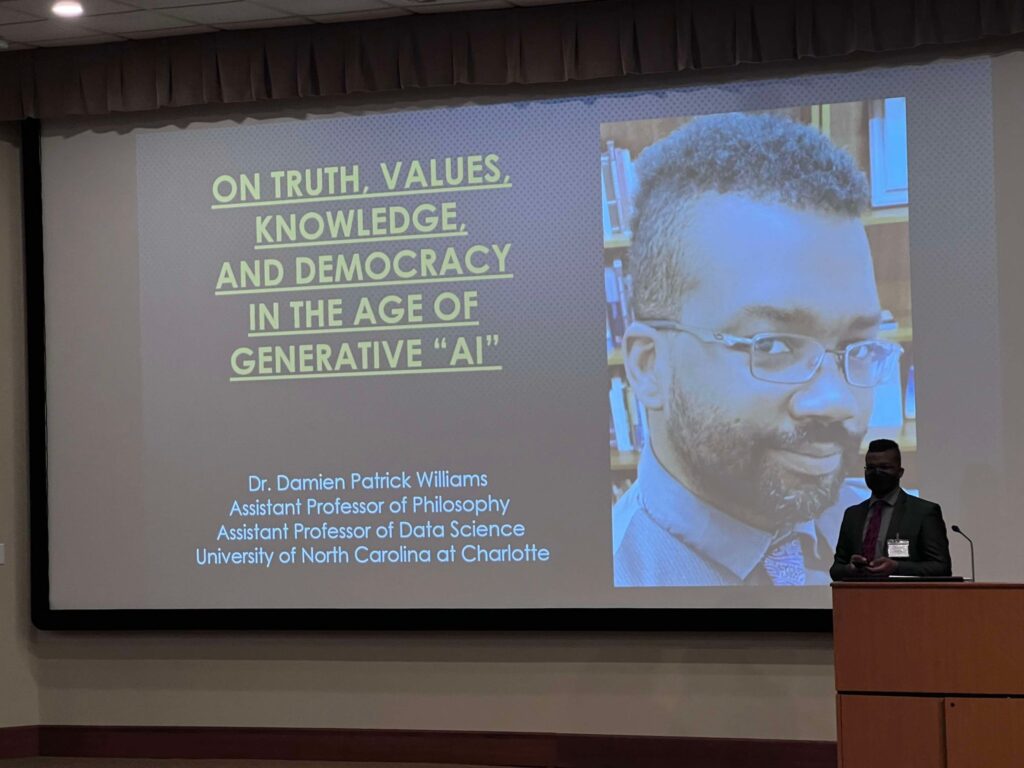
Back in October, I was the keynote speaker for the Society for Ethics Across the Curriculum‘s 25th annual conference. My talk was titled “On Truth, Values, Knowledge, and Democracy in the Age of Generative ‘AI,’” and it touched on a lot of things that I’ve been talking and writing about for a while (in fact, maybe the title is familiar?), but especially in the past couple of years. Covered deepfakes, misinformation, disinformation, the social construction of knowledge, artifacts, and consensus reality, and more. And I know it’s been a while since the talk, but it’s not like these things have gotten any less pertinent, these past months.

As a heads-up, I didn’t record the Q&A because I didn’t get the audience’s permission ahead of time, and considering how much of this is about consent, that’d be a little weird, yeah? Anyway, it was in the Q&A section where we got deep into the environmental concerns of water and power use, including ways to use those facts to get through to students who possibly don’t care about some of the other elements. There were a honestly a lot of really trenchant questions from this group, and I was extremely glad to meet and think with them. Really hoping to do so more in the future, too.

A Black man with natural hair shaved on the sides & long in the center, grey square-frame glasses, wearing a silver grey suit jacket, a grey dress shirt with a red and black Paisley tie, and a black N95 medical mask stands on a stage behind a lectern and in front of a large screen showing a slide containing the words On Truth, Values, Knowledge,and Democracy in the Age of Generative “AI”Dr. Damien Patrick Williams Assistant Professor of Philosophy Assistant Professor of Data Science University of North Carolina at Charlotte, and an image of the same man, unmasked, with a beard, wearing a silver-grey pinstriped waistcoat & a dark grey shirt w/ a purple paisley tie in which bookshelves filled w/ books & framed degrees are visible in the background

Me at the SEAC conference; photo taken by Jason Robert (see alt text for further detailed description).

Below, you’ll find the audio, the slides, and the lightly edited transcript (so please forgive any typos and grammatical weirdnesses). All things being equal, a goodly portion of the concepts in this should also be getting worked into a longer paper coming out in 2025.

Hope you dig it.

Until Next Time.

Continue Reading

Much of my research deals with the ways in which bodies are disciplined and how they go about resisting that discipline. In this piece, adapted from one of the answers to my PhD preliminary exams written and defended two months ago, I “name the disciplinary strategies that are used to control bodies and discuss the ways that bodies resist those strategies.” Additionally, I address how strategies of embodied control and resistance have changed over time, and how identifying and existing as a cyborg and/or an artificial intelligence can be understood as a strategy of control, resistance, or both.

In Jan Golinski’s Making Natural Knowledge, he spends some time discussing the different understandings of the word “discipline” and the role their transformations have played in the definition and transmission of knowledge as both artifacts and culture. In particular, he uses the space in section three of chapter two to discuss the role Foucault has played in historical understandings of knowledge, categorization, and disciplinarity. Using Foucault’s work in Discipline and Punish, we can draw an explicit connection between the various meanings “discipline” and ways that bodies are individually, culturally, and socially conditioned to fit particular modes of behavior, and the specific ways marginalized peoples are disciplined, relating to their various embodiments.

This will demonstrate how modes of observation and surveillance lead to certain types of embodiments being deemed “illegal” or otherwise unacceptable and thus further believed to be in need of methodologies of entrainment, correction, or reform in the form of psychological and physical torture, carceral punishment, and other means of institutionalization.

Locust, “Master and Servant (Depeche Mode Cover)”

Continue Reading

Below are the slides, audio, and transcripts for my talk ‘”Any Sufficiently Advanced Neglect is Indistinguishable from Malice”: Assumptions and Bias in Algorithmic Systems,’ given at the 21st Conference of the Society for Philosophy and Technology, back in May 2019.

(Cite as: Williams, Damien P. ‘”Any Sufficiently Advanced Neglect is Indistinguishable from Malice”: Assumptions and Bias in Algorithmic Systems;’ talk given at the 21st Conference of the Society for Philosophy and Technology; May 2019)

Now, I’ve got a chapter coming out about this, soon, which I can provide as a preprint draft if you ask, and can be cited as “Constructing Situated and Social Knowledge: Ethical, Sociological, and Phenomenological Factors in Technological Design,” appearing in Philosophy And Engineering: Reimagining Technology And Social Progress. Guru Madhavan, Zachary Pirtle, and David Tomblin, eds. Forthcoming from Springer, 2019. But I wanted to get the words I said in this talk up onto some platforms where people can read them, as soon as possible, for a  couple of reasons.

First, the Current Occupants of the Oval Office have very recently taken the policy position that algorithms can’t be racist, something which they’ve done in direct response to things like Google’s Hate Speech-Detecting AI being biased against black people, and Amazon claiming that its facial recognition can identify fear, without ever accounting for, i dunno, cultural and individual differences in fear expression?

[Free vector image of a white, female-presenting person, from head to torso, with biometric facial recognition patterns on her face; incidentally, go try finding images—even illustrations—of a non-white person in a facial recognition context.]


All these things taken together are what made me finally go ahead and get the transcript of that talk done, and posted, because these are events and policy decisions about which I a) have been speaking and writing for years, and b) have specific inputs and recommendations about, and which are, c) frankly wrongheaded, and outright hateful.

And I want to spend time on it because I think what doesn’t get through in many of our discussions is that it’s not just about how Artificial Intelligence, Machine Learning, or Algorithmic instances get trained, but the processes for how and the cultural environments in which HUMANS are increasingly taught/shown/environmentally encouraged/socialized to think is the “right way” to build and train said systems.

That includes classes and instruction, it includes the institutional culture of the companies, it includes the policy landscape in which decisions about funding and get made, because that drives how people have to talk and write and think about the work they’re doing, and that constrains what they will even attempt to do or even understand.

All of this is cumulative, accreting into institutional epistemologies of algorithm creation. It is a structural and institutional problem.

So here are the Slides:

The Audio:

[Direct Link to Mp3]

And the Transcript is here below the cut:

Continue Reading

(This was originally posted over at Medium, [well parts were originally posted in the newslettter, but], but I wanted it somewhere I could more easily manage.)


Hey.

I just wanna say (and you know who you are): I get you were scared of losing your way of life — the status quo was changing all around you. Suddenly it wasn’t okay anymore to say or do things that the world previously told you were harmless. People who didn’t “feel” like you were suddenly loudly everywhere, and no one just automatically believed what you or those you believed in had to say, anymore. That must have been utterly terrifying.

But here’s the thing: People are really scared now. Not just of obsolescence, or of being ignored. They’re terrified for their lives. They’re not worried about “the world they knew.” They’re worried about whether they’ll be rounded up and put in camps or shot or beaten in the street. Because, you see, many of the people who voted for this, and things like it around the world, see many of us — women, minorities, immigrants, LGBTQIA folks, disabled folks, neurodivergent folks — as less than “real” people, and want to be able to shut us up using whatever means they deem appropriate, including death.

The vice president elect thinks gay people can be “retrained,” and that we should attempt it via the same methods that make us side-eye dog owners. The man tapped to be a key advisor displays and has cultivated an environment of white supremacist hatred. The president-elect is said to be “mulling over” a registry for Muslim people in the country. A registry. Based on your religion.

My own cousin had food thrown at her in a diner, right before the election. And things haven’t exactly gotten better, since then.

Certain hateful elements want many of us dead or silent and “in our place,” now, just as much as ever. And all we want and ask for is equal respect, life, and justice.

I said it on election night and I’ll say it again: there’s no take-backsies, here. I’m speaking to those who actively voted for this, or didn’t actively plant yourselves against it (and you know who you are): You did this. You cultivated it. And I know you did what you thought you had to, but people you love are scared, because their lives are literally in danger, so it’s time to wake up now. It’s time to say “No.”

We’re all worried about jobs and money and “enough,” because that’s what this system was designed to make us worry about. Your Muslim neighbour, your gay neighbour, your trans neighbour, your immigrant neighbour, your NEIGHBOUR IS NOT YOUR ENEMY. The system that tells you to hate and fear them is. And if you bought into that system because you couldn’t help being afraid then I’m sorry, but it’s time to put it down and Wake Up. Find it in yourself to ask forgiveness of yourself and of those you’ve caused mortal terror. If you call yourself Christian, that should ring really familiar. But other faiths (and nonfaiths) know it too.

We do better together. So it’s time to gather up, together, work, together, and say “No,” together.

So snap yourself out of it, and help us. If you’re in the US, please call your representatives, federal and local. Tell them what you want, tell them why you’re scared. Tell them that these people don’t represent our values and the world we wish to see:
http://www.house.gov/representatives/find/
http://www.senate.gov/senators/contact/

Because this, right here, is the fundamental difference between fearing the loss of your way of life, and the fear of losing your literal life.

Be with the people you love. Be by their side and raise their voices if they can’t do it for themselves, for whatever reason. Listen to them, and create a space where they feel heard and loved, and where others will listen to them as well.

And when you come around, don’t let your pendulum swing so far that you fault those who can’t move forward, yet. Please remember that there is a large contingent of people who, for many various reasons, cannot be out there protesting. Shaming people who have anxiety, depression, crippling fear of their LIVES, or are trying to not get arrested so their kids can, y’know, EAT FOOD? Doesn’t help.

So show some fucking compassion. Don’t shame those who are tired and scared and just need time to collect themselves. Urge and offer assistance where you can, and try to understand their needs. Just do what you can to help us all believe that we can get through this. We may need to lean extra hard on each other for a while, but we can do this.

You know who you are. We know you didn’t mean to. But this is where we are, now. Shake it off. Start again. We can do this.


If you liked this article, consider dropping something into the A Future Worth Thinking About Tip Jar