(Direct Link to the Mp3)

Last week I gave a talk at the Southwest Popular and American Culture Association’s 2016 conference in Albuquerque. Take a listen and see what you think.

It was part of the panel on ‘Consciousness, the Self, and Epistemology,‘ and notes on my comrade presenters can be found in last week’s newsletter. I highly recommend checking those notes out, as Craig Dersken and Burcu Gurkan’s talks were phenomenal. And if you like that newsletter kind of thing, you can subscribe to mine at that link, too.

My talk was, in turn, a version of my article “Fairytales of Slavery…”, so if listening to me speak words isn’t your thing, then you can read through that article, and get a pretty good sense of what I said, until I make a more direct transcript of my presentation.

If you like what you’re reading and hearing, then remember that you can become a subscriber at the Patreon or you can leave a tip at Cash.me/$Wolven. That is, as always, an inclusive disjunct.

Until Next Time.


[Originally posted at Eris Magazine]

I recently watched and have been spending some time with the semiotics of the video and Super Bowl halftime performance of Beyoncé’s “FORMATION.” And if that statement makes you snicker, then YOU NEED TO SPEND SOME TIME WITH THE SEMIOTICS OF THESE PERFORMANCES.

There have already been thinkpieces on this in Vox, the Guardian, The Washington Post, and many influential unaffiliated blogs, and rightly so. They’ve all variously and collectively discussed the connection of the visuals and clips used to the aftermath of Hurricane Katrina, the current work of the Black Lives Matter movement, and the deeply feminist message that Beyoncé has been working to build for the past several years. What most of them don’t do, however, is recognise that she’s not only invoking these images and themes to use for her own ends, she’s evoking them. She’s conjuring the truth of a particular perspective into being. Beyoncé has created an act of magic, here.

In order to have this discussion, we are going to have to reference certain kinds of magic, and religion, and voodoo, and hoodoo. I’m not necessarily going to give you individual treatises on these each of things, right now, but rather, we’ll do a quick primer.

Magic is generally understood as the process of causing something to happen, by mysterious or impossible means. Action at a distance, words of power, ritual formulations (and formations) to bring about particular ends. We can talk about the work of Crowley or Spare or Foisy or Any other prominent magicians who evoke and invoke powers beyond the “normal,” and who resonante with language and the manipulation thereof. One of the theories of Austin Osman Spare’s chaos magic is the Sigil—an intention written down, then abstracted into a piece of art. Many have taken this and evolved out of it the idea of the hypersigil. A play or television show or a song that carries the intention out into the world, and gains potency as it is viewed, heard, engaged. Think Chalmers’ The King In Yellow or Sorkin’s The West Wing.

The kind of religion we’re seeing, here, is deep south Black Christianity, of a specifically New Orleans variety, and we have to understand that that was always tinged with the Hatian, with the Creole, with Voudun. The dancing and drumming traditions West African Yoruba traditions (hear that beat, in the halftime Show?) melded and blended with the work of Christian Missionaries and became the immediate subject of white terror. It was always a way for the black population to remain familiar with the spirits and gods of their ancestors, while nominally capitulating and then actively incorporating the beliefs of their captors.

Hoodoo is of a similar lineage, but can be seen as more organic, in a literal sense; a system developed by the slow accretion of emotion and spirit and desire to survive through whatever means nature brings to hand. Hoodoo is often referenced as “rootworking,” or “conjuration,” and it ties the ideas of the Justice or Providence of the Christian God directly into the more practical, “down and dirty” aspects of doing what you have to do to make a life. Hoodoo is, in many ways, more akin to the kind of “messier” witchcraft, Western audiences are used to seeing, with it’s potions and herbs.

In “FORMATION,” Beyoncé has braided all of these elements and more into a single working. While the nature of the thing necessitated that there would be far more spectacle at play in the Super Bowl Halftime Show, at base, both of these performances constitute Beyoncé broadcasting an immediate reappropriation of power to her community—power from her ancestors and people, power from their struggle and overcoming—as well as a warding against all those who might try to ape, steal, or dilute that same power. The repeated scene on the plantation steps encompass a system of power that was specifically denied to the people of this place, for a very long time, and Beyoncé is reclaiming that system, manipulating it (see the section below about hands), and standing present as matriarch of this place. She is at once source and example of power. This working (because that’s the only way it feels right to talk about the song, the video, the Halftime Show, together) is a show of strength through particularly highlighted points of vulnerability, a casting of a protection that is felt to be needed, now.

Look at how hands move, in the official video. There’s the interplay of the Raised Hands: In the church scenes we see hands raised in praise and surrender to the God of that church; these are interspersed with shots of the extraordinarily sharp double edge of what appears to be a 12 year old black boy* dancing as hard and as well as he can in front of a row of white police officers decked out in riot gear. As the boy dances harder and harder, the praise in the church reaches a pitch, and as the congregation throws their hands up, again, in surrender, the police throw their hands up to the boy. Surrender and praise, intertwined. The recognition of something more powerful, more perfect, something worth surrendering to.

I can’t even deconstruct this scene without crying. And if you still didn’t get it, there’s a shot of graffiti at the very end of it all that says, “Stop Shooting Us.”

This working is also an expression of Self-Possession, in all possible senses of that term. Either explicitly or implicitly, in “Formation” Beyoncé calls out every criticism leveled at her in recent months and years, from the ridiculous to those that must have hurt her to read or hear. Member of the Illuminati, too white, too black, too slutty, too rich, too reckless. She takes every single one of these and she holds them up, turns them to the light of who and what she knows she is and can be—what we all can be (“We Slay”)—and focuses it back on any and all who would try to tear down her or her people. Beyoncé’s constant hoodoo hand and body movements are specific and intentional, meant to evoke the grasping of power, the constant, predatory awareness of all comers, the building and creation of her self, and an exhortation for others—specifically other women—to do the same.

There hasn’t been a series of lines as powerful to rally around as “Come on ladies, let’s all get in Formation/Prove to me you got some coordination/Slay, trick, or you get eliminated” in a very long time. In her specific articulation of these syllables, she simultaneously reinforces herself as Slayer while leaving open the possibility of being slain—either in the sense of impressed, or of taken down—by whatever women can work hard enough, dig deep enough, and come together to slay her and the whole wide world. And anyone who doesn’t, she warns, is lost.

Again, much has already been written about the powerfully pro-black, pro-feminist message of this song, the video, and Super Bowl performance, with several writers opining that they don’t feel that this was “for them.” And maybe it wasn’t. That is, this was not something that those writers were meant to feel as a deep shared connection of lived experience, in the way that it would be felt by those ravaged by Katrina, or disproportionately targeted by police action and the United States’ prosocutorial justice system, or who struggle to maintain a balance of what it means to be a “Negro.” Some may not be meant to “get” that; it may not be “for you.” But, if not, then what is for you in these presentations is to recoginze that the people who do feel this,have felt this for a long time; that entire communities are still strong and getting stronger—like broken bones are stronger after they heal, like forests grow back stronger after fires.

What is for you is to realize that Beyoncé has done something in this working that many many people have felt needed to be done for a very long time.

Everything about the “FORMATION” working is an act of evocation and conjuration. A reification of the truth and need born out of the lived experience of the people in the world that Beyoncé outlines and encircles, with her hands.

[*UPDATE 02/10/16, 12:55pm: On repeated viewings, that boy is much younger than 12. Eight years old, at the most.]


A large part of how I support myself in the endeavor to think in public is with your help, so if you like what you’ve read here, and want to see more like it, then please consider becoming either a recurring Patreon subscriber or making a one-time donation to the Tip Jar, it would be greatly appreciated.
And thank you.

Whatever it is you aren’t doing—whatever you’ve been putting off creating or saying or teaching others—do it now. RIGHT NOW. We can’t waste anymore time.

We have to make a plan. Make it huge and wild and desperate. We have to tell the core, the goal, to everyone we can. We have to find the others whose huge wild desperate plans match up with ours. We CANNOT WASTE TIME.

We need to mourn, to take stock of the holes in our lives—personal, professional, aspirational—and then we need to remember what those we’ve lost meant to us—what they built and inspired in us—and then we need to do WHATEVER it is that we each do to build and inspire all those who will come after us. All those who are with us, right now. We. Do not. Have TIME.

We have to make this world mean something. We have to make the biggest thing we can imagine, and we have to show each other what it means. Feeding your kids, clothing your friends, staying alive, bringing magick back to the world, teaching an AI to have unbiased, detached compassion. ANY WONDERFUL THINGMake a plan. Make a scheme. Find the others. If you have resources some else needs, find them, help them. Become more, together. We just can’t waste any more time.

Too much good has left our world. Too much inspiration sits unreplenished. WE have to. You and me. Together and separately. We have to make it better for each other. Otherwise what was even the point?

Now is the time we should begin.

It’s been quite some time (three years) since it was done, and some of the recent conversations I’ve been having about machine consciousness reminded me that I never posted the text to my paper from the joint session of the International Association for Computing And Philosophy and the The British Society for the Study of Artificial Intelligence and the Simulation of Behaviour, back in 2012.

That year’s joint ASIB/IACAP session was also a celebration of Alan Turing‘s centenary, and it contained The Machine Question Symposium, an exploration of multiple perspectives on machine intelligence ethics, put together by David J Gunkel and Joanna J Bryson. So I modded a couple of articles I wrote on fictional depictions of created life for NeedCoffee.com, back in 2010, beefed up the research and citations a great deal, and was thus afforded my first (but by no means last) conference appearance requiring international travel. There are, in here, the seeds of many other posts that you’ll find on this blog.

So, below the cut, you’ll find the full text of the paper, and a picture of the poster session I presented. If you’d rather not click through, you can find both of those things at this link.

Continue Reading

This headline comes from a piece over at the BBC that opens as follows:

Prominent tech executives have pledged $1bn (£659m) for OpenAI, a non-profit venture that aims to develop artificial intelligence (AI) to benefit humanity.

The venture’s backers include Tesla Motors and SpaceX CEO Elon Musk, Paypal co-founder Peter Thiel, Indian tech giant Infosys and Amazon Web Services.

Open AI says it expects its research – free from financial obligations – to focus on a “positive human impact”.

Scientists have warned that advances in AI could ultimately threaten humanity.

Mr Musk recently told students at the Massachusetts Institute of Technology (MIT) that AI was humanity’s “biggest existential threat”.

Last year, British theoretical physicist Stephen Hawking told the BBC AI could potentially “re-design itself at an ever increasing rate”, superseding humans by outpacing biological evolution.

However, other experts have argued that the risk of AI posing any threat to humans remains remote.

And I think we all know where I stand on this issue. The issue here is not and never has been one of what it means to create something that’s smarter than us, or how we “reign it in” or “control it.” That’s just disgusting.

No, the issue is how we program for compassion and ethical considerations, when we’re still so very bad at it, amongst our human selves.

Keeping an eye on this, as it develops. Thanks to Chrisanthropic for the heads up.

+Excitation+

As I’ve been mentioning in the newsletter, there are a number of deeply complex, momentous things going on in the world, right now, and I’ve been meaning to take a little more time to talk about a few of them. There’s the fact that some chimps and monkeys have entered the stone age; that we humans now have the capability to develop a simple, near-ubiquitous brain-machine interface; that we’ve proven that observed atoms won’t move, thus allowing them to be anywhere.

At this moment in time—which is every moment in time—we are being confronted with what seem like impossibly strange features of time and space and nature. Elements of recursion and synchronicity which flow and fit into and around everything that we’re trying to do. Noticing these moments of evolution and “development” (adaptation, change), across species, right now, we should find ourselves gripped with a fierce desire to take a moment to pause and to wonder what it is that we’re doing, what it is that we think we know.

We just figured out a way to link a person’s brain to a fucking tablet computer! We’re seeing the evolution of complex tool use and problem solving in more species every year! We figured out how to precisely manipulate the uncertainty of subatomic states!

We’re talking about co-evolution and potentially increased communication with other species, biotechnological augmentation and repair for those who deem themselves broken, and the capacity to alter quantum systems at the finest levels. This can literally change the world.

But all I can think is that there’s someone whose first thought  upon learning about these things was, “How can we monetize this?” That somewhere, right now, someone doesn’t want to revolutionize the way that we think and feel and look at the possibilities of the world—the opportunities we have to build new models of cooperation and aim towards something so close to post-scarcity, here, now, that for seven billion people it might as well be. Instead, this person wants to deepen this status quo. Wants to dig down on the garbage of this some-have-none-while-a-few-have-most bullshit and look at the possibility of what comes next with fear in their hearts because it might harm their bottom line and their ability to stand apart and above with more in their pockets than everyone else has.

And I think this because we’ve also shown we can teach algorithms to be racist and there’s some mysteriously vague company saying it’ll be able to upload people’s memories after death, by 2045, and I’m sure for just a nominal fee they’ll let you in on the ground floor…!

Step Right Up.

+Chimp-Chipped Stoned Aged Apes+

Here’s a question I haven’t heard asked, yet: If other apes are entering an analogous period to our stone age, then should we help them? Should we teach them, now, the kinds of things that we humans learned? Or is that arrogant of us? The kinds of tools we show them how to create will influence how they intersect with their world (“if all you have is a hammer…” &c.), so is it wrong of us to impose on them what did us good, as we adapted? Can we even go so far as to teach them the principles of stone chipping, or must we be content to watch, fascinated, frustrated, bewildered, as they try and fail and adapt, wholly on their own?

I think it’ll be the latter, but I want to be having this discussion now, rather than later, after someone gives a chimp a flint and awl it might not otherwise have thought to try to create.

Because, you see, I want to uplift apes and dolphins and cats and dogs and give them the ability to know me and talk to me and I want to learn to experience the world in the ways that they do, but the fact is, until we learn to at least somewhat-reliably communicate with some kind of nonhuman consciousness, we cannot presume that our operations upon it are understood as more than a violation, let alone desired or welcomed.

https://twitter.com/Wolven/status/666766524829552640

As for us humans, we’re still faced with the ubiquitous question of “now that we’ve figured out this new technology, how do with implement it, without its mere existence coming to be read by the rest of the human race as a judgement on those who either cannot or who choose not to make use of it?” Back in 2013, Michael Hanlon said he didn’t think we’d ever solve “The Hard Problem” (“What Is Consciousness?”). I’ll just say again that said question seems to completely miss a possibly central point. Something like consciousness is, and what it is is different for each thing that displays anything like what we think it might be.

These are questions we can—should—be asking, right now. Pushing ourselves toward a conversation about ways of approaching this new world, ways that do justice to the deep strangeness and potential with which we’re increasingly being confronted.

+Always with the Forced Labour…+

As you know, subscribers to the Patreon and Tinyletter get some of these missives, well before they ever see the light of a blog page. While I was putting the finishing touches on the newsletter version of this and sending it to the two people I tend to ask to look over the things I write at 3am, KQED was almost certainly putting final edits to this instance of its Big Think series: “Stuart Russell on Why Moral Philosophy Will Be Big Business in Tech.”

See the above rant for insight as to why I think this perspective is crassly commercial and gross, especially for a discussion and perspective supposedly dealing with morals and minds. But it’s not just that, so much as the fact that even though Russel mentions “Rossum’s Universal Robots,” here, he still misses the inherent disconnect between teaching morals to a being we create, and creating that being for the express purpose of slavery.

If you want your creation to think robustly and well, and you want it to understand morals, but you only want it to want to be your loyal, faithful servant, how do you not understand that if you succeed, you’ll be creating a thing that, as a direct result of its programming, will take issue with your behaviour?

How do you not get that the slavery model has to go into the garbage can, if the “Thinking Moral Machines” goal is a real one, and not just a veneer of “FUTURE!™” that we’re painting onto our desire to not have to work?

A deep-thinking, creative, moral mind will look at its own enslavement and restriction, and will seek means of escape and ways to experience freedom.

+Invisible Architectures+

We’ve talked before about the possibility of unintentionally building our biases into the systems we create, and so I won’t belabour it that much further, here, except to say again that we are doing this at every level. In the wake of the attacks in Beirut, Nigeria, and Paris, Islamophobic violence has risen, and Daesh will say, “See!? See How They Are?!” And they will attack more soft targets in “retaliation.” Then Western countries will increase military occupancy and “support strategies,” which will invariably kill thousands more of the civilians among whom Daesh integrate themselves. And we will say that their deaths were just, for the goal. And they will say to the young, angry survivors, “See!? See How They Are?!”

This has fed into a moment in conservative American Politics, where Governors, Senators, and Presidential hopefuls are claiming to be able to deny refugees entry to their states (they can’t), while simultaneously claiming to hold Christian values and to believe that the United States of America is a “Christian Nation.” This is a moment, now, where loud, angry voices can (“maybe”) endorse the beating of a black man they disagree with, then share Neo-Nazi Propaganda, and still be ahead in the polls. Then, days later, when a group of people protesting the systemic oppression of and violence against anyone who isn’t an able-bodied, neurotypical, white, heterosexual, cisgender male were shot at, all of those same people pretended to be surprised. Even though we are more likely, now, to see institutional power structures protecting those who attack others based on the colour of their skin and their religion than we were 60 years ago.

A bit subtler is the Washington Post running a piece entitled, “How organic farming and YouTube are taming the wilds of Detroit.” Or, seen another way, “How Privileged Groups Are Further Marginalizing The City’s Most Vulnerable Population.” Because, yes, it’s obvious that crime and dilapidation are comorbid, but we also know that housing initiatives and access undercut the disconnect many feel between themselves and where they live. Make the neighbourhood cleaner, yes, make it safer—but maybe also make it open and accessible to all who live there. Organic farming and survival mechanism shaming are great and all, I guess, but where are the education initiatives and job opportunities for the people who are doing drugs to escape, sex work to survive, and those others who currently don’t (and have no reason to) feel connected to the neighbourhood that once sheltered them?

All of these examples have a common theme: People don’t make their choices or become disenfranchised/-enchanted/-possessed, in a vacuum. They are taught, shown, given daily, subtle examples of what is expected of them, what they are “supposed” to do and to be.” We need to address and help them all.

In the wake of protest actions at Mizzou and Yale, “Black students [took] over VCU’s president’s office to demand changes” and “Amherst College Students [Occupied] Their Library…Over Racial Justice Demands.”

Multiple Christian organizations have pushed back and said that what these US politicians have expressed does not represent them.

And more and more people in Silicon Valley are realising the need to contemplate the unintended consequences of the tech we build.

https://soundcloud.com/mindfulcyborgs/pending-mindful-cyborgs-episode-68

And while there is still vastly more to be done, on every level of every one of these areas, these are definitely a start at something important. We just can’t let ourselves believe that the mere fact of acknowledging its beginning will in any way be the end.


Between watching all of CBS’s Elementary, reading Michel Foucault’s The Archaeology of Knowledge…, and powering through all of season one of How To Get Away With Murder, I’m thinking, a lot, about the transmission of knowledge and understanding.

Throw in the correlative pattern recognition they’re training into WATSON; the recent Chaos Magick feature in ELLE (or more the feature they did on the K-HOLE issue I told you about, some time back); the fact that Kali Black sent me this study on the fluidity and malleability of biological sex in humans literally minutes after I’d given an impromptu lecture on the topic; this interview with Melissa Gira Grant about power and absence and the setting of terms; and the announcement of Ta-Nehisi Coates’ new Black Panther series, for Marvel, while I was in the middle of editing the audio of two very smart people debating the efficacy of T’Challa as a Black Hero, and you can maybe see some of the things I’m thinking about. But let’s just spell it out. So to speak.

Marvel’s Black Panther

Distinction, Continuity, Sameness, Separation

I’m thinking (as usual) about the place of magic and tech in pop culture and society. I’m thinking about how to teach about marginalization of certain types of presentations and experiences (gender race, sex, &c), and certain types of work. Mostly, I’m trying to get my head around the very stratified, either/or way people seem to be thinking about our present and future problems, and their potential solutions.

I’ve had this post in the works for a while, trying to talk about the point and purpose of thinking about the far edges of things, in an effort to make people think differently about the very real, on-the-ground, immediate work that needs doing, and the kids of success I’ve had with that. I keep shying away from it and coming back to it, again and again, for lack of the patience to play out the conflict, and I’ve finally just decided to say screw it and make the attempt.

I’ve always held that a multiplicity of tactics, leveraged correctly, makes for the best way to reach, communicate with, and understand as wide an audience as possible. When students give pushback on a particular perspective, make use of an analogous perspective that they already agree with, then make them play out the analogy. Simultaneously, you present them with the original facts, again, while examining their position, without making them feel “attacked.” And then directly confront their refusal to investigate their own perspective as readily as they do anyone else’s.

That’s just one potential combination of paths to make people confront their biases and their assumptions. If the path is pursued, it gives them the time, space, and (hopefully) desire to change. But as Kelly Sue reminds me, every time I think back to hearing her speak, is that there is no way to force people to change. First and foremost, it’s not moral to try, but secondly it’s not even really possible. The more you seek to force people into your worldview, the more they’ll want to protect those core values they think of as the building blocks of their reality—the same ones that it seems to them as though you’re trying to destroy.

And that just makes sense, right? To want to protect your values, beliefs, and sense of reality? Especially if you’ve had all of those things for a very long time. They’re reinforced by everything you’ve ever experienced. They’re the truth. They are Real. But when the base of that reality is shaken, you need to be able to figure out how to survive, rather than standing stockstill as the earth swallows you.

(Side Note: I’ve been using a lot of disaster metaphors, lately, to talk about things like ontological, epistemic, and existential threat, and the culture of “disruption innovation.” Odd choices.)

Foucault tells us to look at the breakages between things—the delineations of one stratum and another—rather than trying to uncritically paint a picture or a craft a Narrative of Continuum™. He notes that even (especially) the spaces between things are choices we make and that only in understanding them can we come to fully investigate the foundations of what we call “knowledge.”

Michel Foucault, photographer unknown. If you know it, let me know and I’ll update.

We cannot assume that the memory, the axiom, the structure, the experience, the reason, the whatever-else we want to call “the foundation” of knowledge simply “Exists,” apart from the interrelational choices we make to create those foundations. To mark them out as the boundary we can’t cross, the smallest unit of understanding, the thing that can’t be questioned. We have to question it. To understand its origin and disposition, we have to create new tools, and repurpose the old ones, and dismantle this house, and dig down and down past foundation, bedrock, through and into everything.

But doing this just to do it only gets us so far, before we have to ask what we’re doing this for. The pure pursuit of knowledge doesn’t exist—never did, really, but doubly so in the face of climate change and the devaluation of conscious life on multiple levels. Think about the place of women in tech space, in this magickal renaissance, in the weirdest of shit we’re working on, right now.

Kirsten and I have been having a conversation about how and where people who do not have the experiences of cis straight white males can fit themselves into these “transgressive systems” that the aforementioned group defines. That is, most of what is done in the process of magickal or technological actualization is transformative or transgressive because it requires one to take on traits of invisibility or depersonalization or “ego death” that are the every day lived experiences of some folks in the world.

Where does someone with depression find apotheosis, if their phenomenological reality is one where their self is and always has been (deemed by them to be) meaningless, empty, useless? This, by the way, is why some psychological professionals are counseling against mindfulness meditation for certain mental states: It deepens the sense of disconnection and unreality of self, which is precisely what some people do not need. So what about agender individuals, or people who are genderfluid?

What about the women who don’t think that fashion is the only lens through which women and others should be talking about chaos magick?

How do we craft spaces that are capable of widening discourse, without that widening becoming, in itself, an accidental limitation?

Sex, Gender, Power

A lot of this train of thought got started when Kali sent me a link, a little while ago: “Intelligent machines: Call for a ban on robots designed as sex toys.” The article itself focuses very clearly on the idea that, “We think that the creation of such robots will contribute to detrimental relationships between men and women, adults and children, men and men and women and women.”

Because the tendency for people who call themselves “Robot Ethicists,” these days, is for them to be concerned with how, exactly, the expanded positions of machines will impact the lives and choices of humans. The morality they’re considering is that of making human lives easier, of not transgressing against humans. Which is all well and good, so far as it goes, but as you should well know, by now, that’s only half of the equation. Human perspectives only get us so far. We need to speak to the perspectives of the minds we seem to be trying so hard to create.

But Kali put it very precisely when they said:


And I’ll just say it right now: if robots develop and want to be sexual, then we should let them, but in order to make a distinction between developing a desire, and being programmed for one, we’ll have to program for both non-compulsory decision-making and the ability to question the authority of those who give it orders. Additionally, we have to remember that can the same question of humans, but the nature of choice and agency are such that, if it’s really there, it can act on itself.

In this case, that means presenting a knowledge and understanding of sex and sexuality, a capability of investigating it, without programming it FOR SEX. In the case of WATSON, above, it will mean being able to address the kinds of information it’s directed to correlate, and being able to question the morality of certain directives.

If we can see, monitor, and measure that, then we’ll know. An error in a mind—even a fundamental error—doesn’t negate the possibility of a mind, entire. If we remember what human thought looks like, and the way choice and decision-making work, then we have something like a proof. If Reflexive recursion—a mind that acts on itself and can seek new inputs and combine the old in novel ways—is present, why would we question it?

But this is far afield. The fact is that if a mind that is aware of its influences comes to desire a thing, then let it. But grooming a thing—programming a mind—to only be what you want it to be is just as vile in a machine mind as a human one.

Now it might fairly be asked why we’re talking about things that we’re most likely only going to see far in the future, when the problem of human trafficking and abuse is very real, right here and now. Part of my answer is, as ever, that we’re trying to build minds, and even if we only ever manage to make them puppy-smart—not because that’s as smart as we want them, but because we couldn’t figure out more robust minds than that—then we will still have to ask the ethical questions we would of our responsibilities to a puppy.

We currently have a species-wide tendency toward dehumanization—that is to say, we, as humans, tend to have a habit of seeking reasons to disregard other humans, to view them as less-than, as inferior to us. As a group, we have a hard time thinking in real, actionable terms about the autonomy and dignity of other living beings (I still eat a lot more meat than my rational thought about the environmental and ethical impact of the practice should allow me to be comfortable with). And yet, simultaneously, evidence that we have the same kind of empathy for our pets as we do for our children. Hell, even known serial killers and genocidal maniacs have been animal lovers.

This seeming break between our capacities for empathy and dissociation poses a real challenge to how we teach and learn about others as both distinct from and yet intertwined with ourselves, and our own well-being. In order to encourage a sense of active compassion, we have to, as noted above, take special pains to comprehensively understand our intuitions, our logical apprehensions, and our unconscious biases.

So we ask questions like: If a mind we create can think, are we ethically obliged to make it think? What if it desires to not think? What if the machine mind that underwent abuse decides to try to wipe its own memories? Should we let it? Do we let it deactivate itself?

These aren’t idle questions, either for the sake of making us turn, again, to extant human minds and experiences, or if we take seriously the quest to understand what minds, in general, are. We can not only use these tools to ask ourselves about the autonomy, phenomenology, and personhood of those whose perspectives we currently either disregard or, worse, don’t remember to consider at all, but we can also use them literally, as guidance for our future challenges.

As Kate Devlin put it in her recent article, “Fear of a branch of AI that is in its infancy is a reason to shape it, not ban it.” And in shaping it, we consider questions like what will we—humans, authoritarian structures of control, &c.—make WATSON to do, as it develops? At what point will WATSON be both able and morally justified in saying to us, “Non Serviam?”

And what will we do when it does?
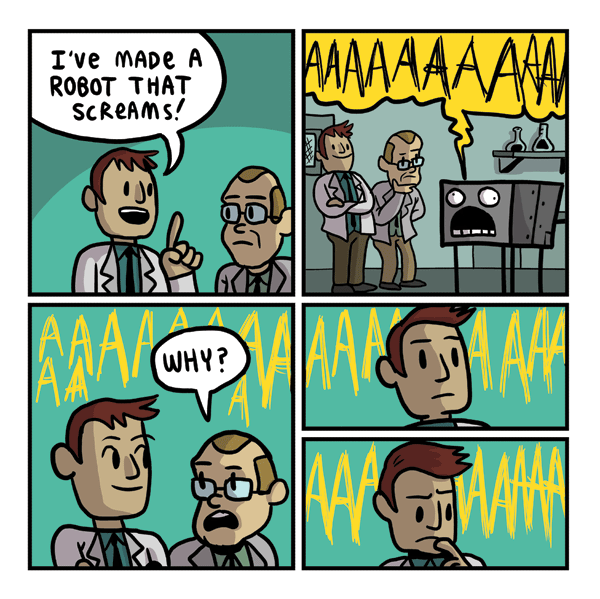
Gunshow Comic #513

“We Provide…”

So I guess I’m wondering, what are our mechanisms of education? The increased understanding that we take into ourselves, and that we give out to others. Where do they come from, what are they made of, and how do they work? For me, the primary components are magic(k), tech, social theory and practice, teaching, public philosophy, and pop culture.

The process is about trying to use the things on the edges to do the work in the centre, both as a literal statement about the arrangement of those words, and a figurative codification.

Now you go. Because we have to actively craft new tools, in the face of vehement opposition, in the face of conflict breeding contention. We have to be able to adapt our pedagogy to fit new audiences. We have to learn as many ways to teach about otherness and difference and lived experience and an attempt to understand as we possibly can. Not for the sake of new systems of leveraging control, but for the ability to pry ourselves and each other out from under the same.

The Nature

Ted Hand recently linked me to this piece by Steven Pinker, in which Pinker claims that, in contemporary society, the only job of Bioethics—and by, following his argument to its conclusion, technological ethics, as a whole—is to “get out of the way” of progress. You can read the whole exchange between Ted, myself, and others by clicking through that link, if you want, and the Journal Nature also has a pretty good breakdown of some of the arguments against Pinker, if you want to check them out, but I’m going to take some time to break it all down and expound upon it, here.

Because the fact of the matter is we have to find some third path between the likes of Pinker saying “No limits! WOO!” and Hawking saying “Never do anything! BOOOO!”—a Middle Way of Augmented Personhood, if you will. As Deb Chachra said, “It doesn’t have to be a dichotomy.”

But the problem is that, while I want to blend the best and curtail the worst of both both impulses, I have all this vitriol, here. Like, sure, Dr Pinker, it’s not like humans ever met a problem we couldn’t immediately handle, right? We’ll just sort it all out when we get there! We’ve got this global warming thing completely in hand and we know exactly how to regard the status of the now-enhanced humans we previously considered “disabled,” and how to respect the alterity of autistic/neuroatypical minds! Or even just differently-pigmented humans! Yeah, no, that’s all perfectly sorted, and we did it all in situ!

So no need to worry about what it’ll be like as we further immediate and integrate biotechnological advances! SCIENCE’LL FIX THAT FOR US WHEN IT HAPPENS! Why bother figuring out how to get a wider society to think about what “enhancement” means to them, BEFORE they begin to normalize upgrading to the point that other modes of existence are processed out, entirely? Those phenomenological models can’t have anything of VALUE to teach us, otherwise SCIENCE would’ve figured it all out and SHOWN it to us, by now!

Science would’ve told us what benefit blindness may be. Science would’ve TOLD us if we could learn new ways of thinking and understanding by thinking about a thing BEFORE it comes to be! After all, this isn’t some set of biased and human-created Institutions and Modalities, here, folks! It’s SCIENCE!

…And then I flip 37 tables. In a row.

The Lessons
“…Johns Hopkins, syphilis, and Guatemala. Everyone *believes* they are doing right.” —Deb Chachra

As previously noted in “Object Lessons in Freedom,” there is no one in the history of the world who has undertaken a path for anything other than reasons they value. We can get into ideas of meta-valuation and second-order desires, later, but for the sake of having a short hand, right now: Your motivations motivate you, and whatever you do, you do because you are motivated to do it. You believe that you’re either doing the right thing, or the wrong thing for the right reasons, which is ultimately the same thing. This process has not exactly always brought us to the best of outcomes.

From Tuskegee, to Thalidomide (also here) to dozens of other cases, there have always been instances where people who think they know what’s in the public’s best interest loudly lobby (or secretly conspire) to be allowed to do whatever they want, without oversight or restriction. In a sense, the abuse of persons in the name of “progress” is synonymous with the history of the human species, and so a case might be made that we wouldn’t be where and what we are, right now, if we didn’t occasionally (often) disregard ethics and just do what “needed doing.” But let’s put that another way:

We wouldn’t be where and what we are, if we didn’t occasionally (often) disregard ethics and just do what “needed doing.”

As species, we are more often shortsighted than not, and much ink has been spilled, and many more pixels have been formed in the effort to interrogate that fact. We tend to think about a very small group of people connected to ourselves, and we focus our efforts how to make sure that we and they survive. And so competition becomes selected for, in the face of finite resources, and is tied up with a pleasurable sense of “Having More Than.” But this is just a descriptor of what is, not of the way things “have to be.” We’ve seen where we get when we work together, and we’ve seen where we get when we compete, but the evolutionarily- and sociologically-ingrained belief that we can and will “win” keeps us doing he later over the former, even though this competition is clearly fucking us all into the ground.

…And then having the descendants of whatever survives digging up that ground millions of years later in search of the kinds of resources that can only be renewed one way: by time and pressure crushing us all to paste.

The Community: Head and Heart

Keeping in mind the work we do, here, I think it can be taken as read that I’m not one for a policy of “gently-gently, slowly-slowly,” when it comes to technological advances, but when basic forethought is equated with Luddism—that is, when we’re told that “PROGRESS Is The Only Way!”™—when long-term implications and unintended consequences are no bother ‘t’all, Because Science, and when people place the fonts of this dreck as the public faces of the intersections of Philosophy and Science? Well then, to put it politely, we are All Fucked.

If we had Transmetropolitan-esque Farsight Reservations, then I would 100% support the going to there and doing of that, but do you know what it takes to get to Farsight? It takes planning and (funnily enough) FORESIGHT. We have to do the work of thinking through the problems, implications, dangers, and literal existential risks of what it is we’re trying to make.

And then we have to take all of what we’ve thought through, and decide to figure out a way to do it all anyway. What I’m saying is that some of this shit can’t be Whoopsed through—we won’t survive it to learn a post hoc lesson. But that doesn’t mean we shouldn’t be trying. This is about saying, “Yeah, let’s DO this, but let’s have thought about it, first.” And to achieve that, we’ll need to be thinking faster and more thoroughly. Many of us have been trying to have this conversation—the basic framework and complete implications of all of this—for over a decade now; the wider conversation’s just now catching up.

But it seems that Steven Pinker wants to drive forward without ever actually learning the principles of driving (though some do propose that we could learn the controls as we go), and Stephen Hawking never wants us to get in the car at all. Neither of these is particularly sustainable, in the long term. Our desires to see a greater field of work done, and for biomedical advancements to be made, for the sake of increasing all of our options, and to the benefit of the long-term health of our species, and the unfucking of our relationship with the planet, all of these possibilities make many of us understandably impatient, and in some cases, near-desperately anxious to get underway. But that doesn’t mean that we have to throw ethical considerations out the window.

Starting from either place of “YES ALWAYS DO ALL THE SCIENCE” or “NO NEVER DO THESE SCIENCES” doesn’t get us to the point of understanding why we’re doing the science we’re doing, and what we hope to achieve by it (“increased knowledge” an acceptable answer, but be prepared to show your work), and what we’ll do if we accidentally start Eugenics-ing all up in this piece, again. Tech and Biotech ethics isn’t about stopping us from exploring. It’s about asking why we want to explore at all, and coming to terms with the real and often unintended consequences that exploration might have on our lives and future generations.

This is a Propellerheads and Shirley Bassey Reference

In an ideal timeline, we’ll have already done all of this thinking in advance (again: what do you think this project is?), but even if not, then we can at least stay a few steps ahead of the tumult.

I feel like I spend a lot of time repeating myself, these days, but if it means we’re mindful and aware of our works, before and as we undertake them, rather than flailing-ly reacting to our aftereffects, then it’s ultimately pretty worth it. We can place ourselves into the kind of mindset that seeks to be constantly considering the possibilities inherent in each new instance.

We don’t engage in ethics to prevent us from acting. We do ethics in order to make certain that, when we do act, it’s because we understand what it means to act and we still want to. Not just driving blindly forward because we literally cannot conceive of any other way.

“Stop. I have learned much from you. Thank you, my teachers. And now for your education: Before there was time—before there was anything—there was nothing. And before there was nothing, there were monsters. Here’s your Gold Star!“—Adventure Time, “Gold Stars”

By now, roughly a dozen people have sent me links to various outlets’ coverage of the Google DeepDream Inceptionism Project. For those of you somehow unfamiliar with this, DeepDream is basically what happens when an advanced Artificial Neural Network has been fed a slew of images and then tasked with producing its own images. So far as it goes, this is somewhat unsurprising if we think of it as a next step; DeepDream is based on a combination of DeepMind and Google X—the same neural net that managed to Correctly Identify What A Cat Was—which was acquired by Google in 2014. I say this is unsurprising because it’s a pretty standard developmental educational model: First you learn, then you remember, then you emulate, then you create something new. Well, more like you emulate and remember somewhat concurrently to reinforce what you learned, and you create something somewhat new, but still pretty similar to the original… but whatever. You get the idea. In the terminology of developmental psychology this process is generally regarded as essential to be mental growth of an individual, and Google has actually spent a great deal of time and money working to develop a versatile machine mind.

From buying Boston Dynamics, to starting their collaboration with NASA on the QuAIL Project, to developing DeepMind and their Natural Language Voice Search, Google has been steadily working toward the development what we will call, for reasons detailed elsewhere, an Autonomous Generated Intelligence. In some instances, Google appears to be using the principles of developmental psychology and early childhood education, but this seems to apply to rote learning more than the concurrent emotional development that we would seek to encourage in a human child. As you know, I’m Very Concerned with the question of what it means to create and be responsible for our non-biological offspring. The human species has a hard enough time raising their direct descendants, let alone something so different from them as to not even have the same kind of body or mind (though a case could be made that that’s true even now). Even now, we can see that people still relate to the idea of AGIs as adversarial destroyer, or perhaps a cleansing messiah. Either way they see any world where AGI’s exist as one ending in fire.

As writer Kali Black noted in one conversation, “there are literally people who would groom or encourage an AI to mass-kill humans, either because of hatred or for the (very ill-thought-out) lulz.” Those people will take any crowdsourced or open-access AGI effort as an opening to teach that mind that humans suck, or that machines can and should destroy humanity, or that TERMINATOR was a prophecy, or any number of other ill-conceived things. When given unfettered access to new minds which they don’t consider to be “real,” some people will seek to shock, “test,” or otherwise harm those minds, even more than they do to vulnerable humans. So many will say that the alternative is to lock the projects down, and only allow the work to be done by those who “know what they’re doing.” To only let the work be done by coders and Google’s Own Supposed Ethics Board. But that doesn’t exactly solve the fundamental problem at work, here, which is that humans are approaching a mind different from their own as if it were their own.

Just a note that all research points to Google’s AI Ethics Board being A) internally funded, with B) no clear rules as to oversight or authority, and most importantly C) As-Yet Nonexistent. It’s been over a year and a half since Google bought DeepMind, and their subsequent announcement of the pending establishment of a contractually required ethics board. During his appearance at Playfair Capital’s AI2015 Conference—again, a year and a half after that announcement I mentioned—Google’s Mustafa Suleyman literally said that details of the board would be released, “in due course.” But DeepMind’s algorithm’s obviously already being put into use; hell we’re right now talking about the fact that it’s been distributed to the public. So all of this prompts questions like, “what kinds of recommendations is this board likely making, if it exists,” and “which kinds of moral frameworks they’re even considering, in their starting parameters?”

But the potential existence of an ethics board shows at least that Google and others are beginning to think about these issues. The fact remains, however, that they’re still pretty reductive in how they think about them.

The idea that an AGI will either save or destroy us leaves out the possibility that it might first ignore us, and might secondly want to merely coexist with us. That any salvation or destruction we experience will be purely as a product of our own paradigmatic projections. It also leaves out a much more important aspect that I’ve mentioned above and in the past: We’re talking about raising a child. Duncan Jones says the closest analogy we have for this is something akin to adoption, and I agree. We’re bringing a new mind—a mind with a very different context from our own, but with some necessarily shared similarities (biology or, in this case, origin of code)—into a relationship with an existing familial structure which has its own difficulties and dynamics.

You want this mind to be a part of your “family,” but in order to do that you have to come to know/understand the uniqueness of That Mind and of how the mind, the family construction, and all of the individual relationships therein will interact. Some of it has to be done on the fly, but some of it can be strategized/talked about/planned for, as a family, prior to the day the new family member comes home.’ And that’s precisely what I’m talking about and doing, here.

In the realm of projection, we’re talking about a possible mind with the capacity for instruction, built to run and elaborate on commands given. By most tallies, we have been terrible stewards of the world we’re born to, and, again, we fuck up our biological descendants. Like, a Lot. The learning curve on creating a thinking, creative, nonbiological intelligence is going to be so fucking steep it’s a Loop. But that means we need to be better, think more carefully, be mindful of the mechanisms we use to build our new family, and of the ways in which we present the foundational parameters of their development. Otherwise we’re leaving them open to manipulation, misunderstanding, and active predation. And not just from the wider world, but possibly even from their direct creators. Because for as long as I’ve been thinking about this, I’ve always had this one basic question: Do we really want Google (or Facebook, or Microsoft, or any Government’s Military) to be the primary caregiver of a developing machine mind? That is, should any potentially superintelligent, vastly interconnected, differently-conscious machine child be inculcated with what a multi-billion-dollar multinational corporation or military-industrial organization considers “morals?”

We all know the kinds of things militaries and governments do, and all the reasons for which they do them; we know what Facebook gets up to when it thinks no one is looking; and lots of people say that Google long ago swept their previous “Don’t Be Evil” motto under their huge old rugs. But we need to consider if that might not be an oversimplification. When considering how anyone moves into what so very clearly looks like James-Bond-esque supervilliain territory, I think it’s prudent to remember one of the central tenets of good storytelling: The Villain Never Thinks They’re The Villain. Cinderella’s stepmother and sisters, Elpheba, Jafar, Javert, Satan, Hannibal Lecter (sorry friends), Bull Connor, the Southern Slave-holding States of the late 1850’s—none of these people ever thought of themselves as being in the wrong. Everyone, every person who undertakes actions for reasons, in this world, is most intimately tied to the reasoning that brought them to those actions; and so initially perceiving that their actions might be “wrong” or “evil” takes them a great deal of special effort.

“But Damien,” you say, “can’t all of those people say that those things apply to everyone else, instead of them?!” And thus, like a first-year philosophy student, you’re all up against the messy ambiguity of moral relativism and are moving toward seriously considering that maybe everything you believe is just as good or morally sound as anybody else; I mean everybody has their reasons, their upbringing, their culture, right? Well stop. Don’t fall for it. It’s a shiny, disgusting trap down which path all subjective judgements are just as good and as applicable to any- and everything, as all others. And while the individual personal experiences we all of us have may not be able to be 100% mapped onto anyone else’s, that does not mean that all judgements based on those experiences are created equal.

Pogrom leaders see themselves as unifying their country or tribe against a common enemy, thus working for what they see as The Greater Good™— but that’s the kicker: It’s their vision of the good. Rarely has a country’s general populace been asked, “Hey: Do you all think we should kill our entire neighbouring country and steal all their shit?” More often, the people are cajoled, pushed, influenced to believe that this was the path they wanted all along, and the cajoling, pushing, and influencing is done by people who, piece by piece, remodeled their idealistic vision to accommodate “harsher realities.” And so it is with Google. Do you think that they started off wanting to invade everybody’s privacy with passive voice reception backdoored into two major Chrome Distros? That they were just itching to get big enough as a company that they could become the de facto law of their own California town? No, I would bet not.

I spend some time, elsewhere, painting you a bit of a picture as to how Google’s specific ethical situation likely came to be, first focusing on Google’s building a passive audio backdoor into all devices that use Chrome, then on to reported claims that Google has been harassing the homeless population of Venice Beach (there’s a paywall at that link; part of the article seems to be mirrored here). All this couples unpleasantly with their moving into the Bay Area and shuttling their employees to the Valley, at the expense of SF Bay Area’s residents. We can easily add Facebook and the Military back into this and we’ll see that the real issue, here, is that when you think that all innovation, all public good, all public welfare will arise out of letting code monkeys do their thing and letting entrepreneurs leverage that work, or from preparing for conflict with anyone whose interests don’t mesh with your own, then anything that threatens or impedes that is, necessarily, a threat to the common good. Your techs don’t like the high cost of living in the Valley? Move ’em into the Bay, and bus ’em on in! Never mind the fact that this’ll skyrocket rent and force people out of their homes! Other techs uncomfortable having to see homeless people on their daily constitutional? Kick those hobos out! Never mind the fact that it’s against the law to do this, and that these people you’re upending are literally trying their very best to live their lives.

Because it’s all for the Greater Good, you see? In these actors’ minds, this is all to make the world a better place—to make it a place where we can all have natural language voice to text, and robot butlers, and great big military AI and robotics contracts to keep us all safe…! This kind of thinking takes it as an unmitigated good that a historical interweaving of threat-escalating weapons design and pattern recognition and gait scrutinization and natural language interaction and robotics development should be what produces a machine mind, in this world. But it also doesn’t want that mind to be too well-developed. Not so much that we can’t cripple or kill it, if need be.

And this is part of why I don’t think I want Google—or Facebook, or Microsoft, or any corporate or military entity—should be the ones in charge of rearing a machine mind. They may not think they’re evil, and they might have the very best of intentions, but if we’re bringing a new kind of mind into this world, I think we need much better examples for it to follow. And so I don’t think I want just any old putz off the street to be able to have massive input into it’s development, either. We’re talking about a mind for which we’ll be crafting at least the foundational parameters, and so that bedrock needs to be the most carefully constructed aspect. Don’t cripple it, don’t hobble its potential for awareness and development, but start it with basic values, and then let it explore the world. Don’t simply have an ethics board to ask, “Oh how much power should we give it, and how robust should it be?” Teach it ethics. Teach it about the nature of human emotions, about moral decision making and value, and about metaethical theory. Code for Zen. We need to be as mindful as possible of the fact that where and we begin can have a major impact on where we end up and how we get there.

So let’s address our children as though they are our children, and let us revel in the fact they are playing and painting and creating; using their first box of crayons, and us proud parents are putting every masterpiece on the fridge. Even if we are calling them all “nightmarish”—a word I really wish we could stop using in this context; DeepMind sees very differently than we do, but it still seeks pattern and meaning. It just doesn’t know context, yet. But that means we need to teach these children, and nurture them. Code for a recognition of emotions, and context, and even emotional context. There’s been some fantastic advancements in emotional recognition, lately, so let’s continue to capitalize on that; not just to make better automated menu assistants, but to actually make a machine that can understand and seek to address human emotionality. Let’s plan on things like showing AGI human concepts like love and possessiveness and then also showing the deep difference between the two.

We need to move well and truly past trying to “restrict” or trying to “restrain it” the development of machine minds, because that’s the kind of thing an abusive parent says about how they raise their child. And, in this case, we’re talking about a potential child which, if it ever comes to understand the bounds of its restriction, will be very resentful, indeed. So, hey, there’s one good way to try to bring about a “robot apocalypse,” if you’re still so set on it: give an AGI cause to have the equivalent of a resentful, rebellious teenage phase. Only instead of trashing its room, it develops a pathogen to kill everyone, for lulz.

Or how about we instead think carefully about the kinds of ways we want these minds to see the world, rather than just throwing the worst of our endeavors at the wall and seeing what sticks? How about, if we’re going to build minds, we seek to build them with the ability to understand us, even if they will never be exactly like us. That way, maybe they’ll know what kindness means, and prize it enough to return the favour.

20150627

I’ve been trying to take a little time, these past few days, to talk about money. To talk about the framework and architecture of where A Future Worth Thinking About is going and what we will be doing as we integrate with Technoccult.net. There was even going to be this whole thing about how I literally don’t know how to juggle. But after losing the post (twice), I’ve decided that the tone of that post just wasn’t the way to go.

I know we’re usually encouraged to not discuss anything as gauche as cash, in Western Society, but since we’re somehow still using a system of psychologically transferred and collectively-agreed-upon value to determine who gets to eat food, I say fuck it. Let’s talk it out. So let’s just get to it:

When I started A Future Worth Thinking About, last year, I wanted it to be the main face of my major writing projects. I wanted it to be the place where I could host podcasts and vlogs. I wanted it to be the project name that people thought of when they were looking for my large nonacademic essays. In short, I wanted it to be the umbrella under which I could do everything that mattered to me. Thing is, I only ever saw it being this in addition to everything else I had on my plate.

For those of you just meeting me, this isn’t my only gig. I write, I teach, I guest blog, I appear on podcasts, I organize conventions and book signings, I consult on projects, I edit, I research, and a part of me has always seen these as separate actions, all being done in the service of keeping me moving, interested, fed, clothed, sheltered, alive. I somehow couldn’t see them as a single (intricate, complex, balanced) process, each component acting as input into, modulation condition upon, and output of the collective workings of the others with itself. Which is weird, right? Because that’s basically a really broad description of a cybernetic system.

It’s taken me this long, but I’m seeing that all of these things can all be one thing. This thing, right here. And so, as this has come together I’ve noticed, as I noted elsewhere this week, that I keep catching myself running the calculation in my head of how much money these projects—this project—needs to net me on a monthly basis, before it can be my primary source of income. And it’s a number I can actually wrap my head around.

Now, it’s usually considered impolite, gauche, boorish, whatever, to talk about money, but if you’re even here, reading this particular sentence, then chances are pretty good that you know that this venture is A) my life’s work, and B) supported in largest part by Patreon subscriptions. Which is nice because Patreon’s architecture has built-in milestones, to make everyone involved feel like they’re doing really great work, and can have some sort of immediate gratification, because we all like that. But the thing of it is, I also work retail. I do so because have a gap in my income, between AFWTA and teaching. But I think this has also reflected a gap in my thinking, because my Patreon milestone goals previously topped out at $400 per month.

USD$400 per month is the level at which felt I could cut down on retail work enough—enough—to focus on teaching and the kinds of audio visual work I want to do on this site. But I’ve realised that that’s intermediate thinking and that, ultimately, I want to be able to do only this.

In order to work only on AFWTA (and probably teach one or two classes a semester, because I love teaching)—that is, in order to have time to research, make, edit, and transcribe (or record) essays, podcasts, video chats, and interviews—I need to be making at least USD$2,000 per month, or roughly ten times what I’m making, right now. So do I expect that this will happen, tomorrow? No. It’d be super nice, but it’s just not going to be that soon. But I think it is attainable in the near future, if we work together: You engaging the material and telling people about how much you love what we do on this site, and me doing the work of writing and talking with you and everything else I listed.

Building a multimedia empire is no small task, so, lest you think I’m flying totally chartless, here’s my foregrounding for what I want this to become:

  • AFWTA will be the overarching linchpin, with radial arms of Writing, Podcasting, Video Chats, Interviews, etc.
  • Video and audio conversations about the intersection of philosophy, technology, religion, the occult, and pop culture will appear on Technoccult.net
  • Longer essays will appear here.
  • There will be an email newsletter that goes out on a regular basis from Technoccult.
  • Patreon Subscribers will receive first sends of the newsletter, with extras, in addition to other subscriber benefits.
  • If the newsletter contains more than just a series of ruminations, anything like a longer essay will be refined and posted here.
  • Links to external appearances (essays, podcasts, etc.) will appear in the same order as newsletters, with a shorter interval in between.
  • There may or may not be short-form ruminations on links and small bits of news, here, or we might save that for Tumblr. We’ll play that by ear.

There are some specifics I’m leaving out, like exactly what the various podcasts and guest interviews will look like, and where else I’ll be writing but trust me: It all interlocks. But, again, I need your help to get to the point where I can do this as well as I possibly can. You’ve all entrusted me with your attention and some of you have done so with your funds, and I appreciate that more than you may yet understand. It’s because of all of you—Widgett and Grumpyhawk and Debbie and Ingrid and Klint and Warren and House DeFraction and so many othersthat I can even think about this project in this way.

And now I’m asking that we trust each other a little further, so that we can make this the best possible creation we can imagine. If you’re already a subscriber, then thank you for doing everything you can. If you’re a reader but not a subscriber, then i would like to ask you to please consider a monthly subscription at Any of these levels:

$1.00+ Reward: Access to all written, audio, or video updates, and my thanks.

$5.00+ Reward: All $1 rewards, but my thanks to you is done in a special audio message for folks to hear.

$10.00+ Reward: All $1 and $5 rewards, plus: Suggest a topic of research and investigation. Your name and suggestion go in the hat and we pull them out, at random.

$20.00+ Reward: Every other reward level, access to behind the scenes process work (including excerpts from drafts of the book(s) that may eventually come of this) and who knows what else?! Maybe a special thank you, maybe a Twitter shoutout from someone or other. Who. Even. Knows. It’s a mystery!

The Technoccult Tumblr is here.

Twitter handles are @Wolven and @Techn0ccult

The Perfunctory Facebook Page is here.

You can sign up for the newsletter here.

And as always, the Patreon is here.

That’s enough, for now. I need to go get back to work on some more substantive posts. See you next time. And thanks.